Tai chi as a martial art · Fürstenzell near Passau
Chen‑style kung fu: soft as silk, firm as a dragon
Chen tai chi is a complete martial art and a strong complement to any other. It builds leg strength and a stable structure and trains the sensitivity to feel incoming forces and redirect them as you choose.
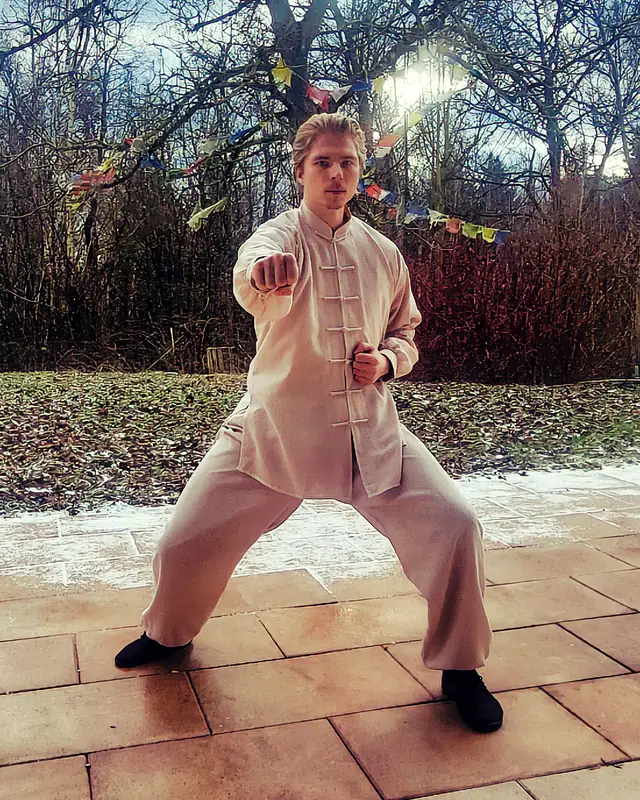
A punch in winter, prayer flags in the background
Three classes
Your path into the martial art
The traditional tai chi class is enough for the foundations. If you want to learn tai chi as a martial art in its own right, you also join the kung fu classes.
Traditional Chen tai chi
The foundation for everything: forms in which every movement contains a concrete application. Punches, elbow and shoulder techniques, locks, blocks, sweeps and kicks, carried by strong legs and a stable core.
Wed + Fri · 7:00 pm
Weijia Kung Fu
External martial art: dynamic and physical, with elements of tui shou (pushing hands), sanshou (free fighting) and sanda (modern combat sport). More athletic than neijia and good for beginners who like it active. And above all, it should be fun.
Fri · 8:30 pm
Neijia Kung Fu
Internal martial art: absorbing, transforming and returning force, as effortlessly as possible and without crude resistance. Mindfulness, intention and inner alignment are trained first in simple exercises and then applied to the eight forces, tui shou and the applications.
Wed · 8:30 pm
Techniques of the Chen style
What you learn
The Chen style combines soft, flowing movements with sudden, powerful releases. In traditional fighting (sanshou) this shows in these skills:
Ting jin: listening to force
Through touch you sense your partner’s force and intention and find the best response.
Hua jin: redirecting force
Attacks are deflected with circular and spiralling movements.
Fajin: explosive power
Sudden bursts of power from the whole body strike with little effort.
Sticking and adhering
At close range you keep contact, control the movement and counter precisely.
Qinna: locks and control
Joint locks and control techniques to hold an opponent in place.
Chansijin: spiral power
Spirals redirect your opponent’s energy and give your own techniques force.
Kicks, sweeps and throws
Unlike many tai chi styles, the Chen style also uses kicks, sweeps and throws.
Our advice
Which classes suit you?
- To complement another martial art: the traditional tai chi class is enough to build leg strength, structure and sensitivity.
- Self-defence, ready sooner: tai chi plus weijia kung fu.
- The deeper forces of tai chi: tai chi plus neijia kung fu.
- The full fighting system: all the classes. Every exercise connects with the others.
If you really want to develop kung fu, you repeat the exercises until they become second nature and grow together into one powerful whole.
Push hands and sanda
Practising with a partner
Alongside forms and applications, push hands (tui shou) is part of the training. In flowing, circling movements you learn to sense your partner’s force, redirect it and return it with precision. This trains relaxation, body awareness and a fine sense of yourself and your partner.
Sanda is a Chinese full-contact system with strikes, kicks, throws and clinch work. It comes from the traditional martial arts, was developed further for competition and is practised today both as a sport and for self-defence.
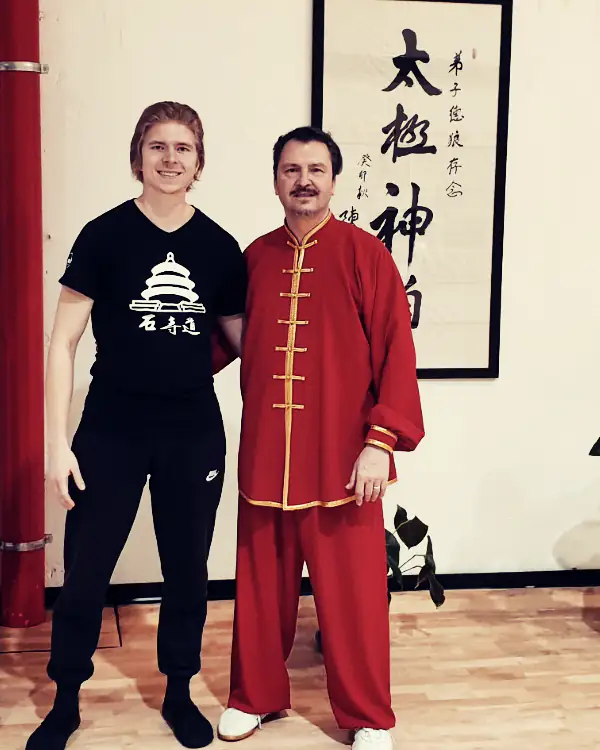
At the Stone Temple Tao school in Treviso
Good to know
Questions about the martial art
Does tai chi help you defend yourself?
Yes, if you practise it as a martial art. The basis isn’t pure muscle strength but relaxation, body awareness and a feel for your opponent. If you want to be able to defend yourself sooner, add weijia kung fu.
Can I do tai chi alongside another martial art?
Absolutely. Strong legs, a stable structure and a feel for an opponent’s force will help you in any combat sport.
Is there sparring or contact?
Partner drills and push hands are part of it, and in weijia kung fu also freer sparring. How much contact depends on your level.
Do I need any equipment?
Not to start with. We’ll talk in class about anything you need later, such as gloves or a practice sword.
Ready for your first session? The trial class is free.
Neijia is on Wednesdays, weijia on Fridays, both from 8:30 pm. Just call ahead.